Showing posts with label Design. Show all posts

2013-04-05

Tutorial: Serouel M'douar - Algerian Urban Costume

So this part of the costume, the pants, are really easy, but it took me ages to find that out, because I couldn't find any desriptions of the cut of these particular pants (serouel in Algerian) that I never happened to see with my own eyes - all I had were photographs. 
The name - serouel m'douar - could have been a useful hint, if I had asked somebody. So the meaning of the name (m'douar means nothing else than "round") became clear to me after a couple of samples that I had tried to make. So here's the description.
You need upholstery fabric which is usually around 3 meters wide. Or you sew a piece which is at least twice as wide as the required length of your serouel (Does that make sense? Lenght: approx 1m; width 2-3m. It depends, how volouminous your serouel should look like and it depends of course on the characteristics of the fabric, stiif or soft, thick or thin).
Now fold your fabric twice. 
Cut out a quarter of a circle, or, if your serouel, like in this case, is longer than wide then the waist is the broadest part and the pants become slimmer towards the ankles in a rounded shape. A small piece between the feet is alredy united.


If you unfold the fabric now you should have a
two semicircular pieces eventually connected on the rounded side.

Pleat the waist, or simply gather it (pleats look less bulky).
Se the side seams and leave generous holes where you feet should go (leave at least 40 cm between them, otherwise you will not be able to walk!) 
Almost done. Waistband and hem at the feet are still missing, but the idea is clear.

2013-04-03

Algerian Urban Costume Step 1: Research

It is one of the worst of my habits not to finish one project before starting the next one... so here I am again.
My fingers have been itching a long time for this and since the other dancing ladies have expressed their interest to work on Algerian Andalusian Dance I am heading to this adventure right now.
The costume-to-be should represent the festive attire of a high-class lady from Algier roughly in the middle of the 19th century in order to create a choreography on classical Algerian Andaloussi Music (explanation will follow...)
The fabulous book of Leyla Belkaid: Costumes d'Algerie, Edtions du Layeur, Paris 2003 offers deep historical explanations and many historical photographs related to this issue.
Below are a couple of variations of a late 19th- early 20th century style of indoor clothing.
 
The first part to explore were the trousers. This particular style is called "serouel m'douar" and is used also nowadays with a slightly different silhouette; as modern ladies want to look more slim they use less and more delicate fabric.


For the historical garments thick and heavy jaquard textiles have been used for the trousers, most probably silk. Nowadays you can use upholstery fabric which has similar characteristics and is relatively cheap.
And here you can see a modern serouel m'douar:
(picture credit: here.)
In the next post I will show you how to sew such a serouel.

2013-03-26

On Reconstructing: What is "Authentic" in Ethnic Dance?

Now that the Kalbeliya costume is finally finished I have collected so many ideas in my head that I am working now not on one "historical" costume, but on two simultaneously.

(N.B.: Rereading this article I have the impression to have written an anti-tribal-fusion statement. I do not at all disrespect any kind of fusion work, on the contrary, it has it's own charm and is an artform in itself! But it has a totally different background than what I am trying to do in this moment.)

When I say "historical" costume this means that I do an accurate research on a specific region and a certain time period. Then I usually choose a whole outfit that I try to reproduce including accessoires like headpieces, shoes and jewellery. On this base I choose the matching music to form a dance out of that.
But when it comes to reconstruction there are a lot of different levels of historical accuracy to follow. How much must my work adhere to them?

Thinking of my next projects these are the questions I posed to myslf and also how to answer them for myself - regarding only my own work right now. I do not want to make any absolute judgements, I just want to clear my ideas in order to achieve a round and coherent outcome!

Modern  version of a traditional Algerian costume  - from a magazine of the famous Algerian Designer Samira Bezaouia Sadek

Can I mix pieces of different outfits?
The answer is difficult. As documentary material may be scarce I will be forced to invent something in any case. BUT - and this is crucial for me - I want to have a coherent work, this means, that if I borrow pieces (and, when it comes to dances, movements) from another, similar source, I want to make sure that the pieces will not loose their initial meaning by being put into an alien surrounding. This may sound really cryptic. I mean, that the pieces should match and should not be used out of their  context regarding religion, social strata and regional peculiarity. So I would not combine, e.g. a peasant woman's apron with an urban headpiece.
Mixing signs of different religious or ethnic communities is not only a sign of a certain ignorance; it might even be regarded as an insult to a member of those. So be very careful with eclectic compositions and have always your audience in mind.
The gender aspect is also very important in non westernized societies. Although I see a certain shift in contemporary ethnic stage dance and costuming (e. g. in some of the new pieces of the sukhilshvilebi from Georgia) I'd rather leave those challenges of their own society to them. As an outsider I can never be sure what denotation it will create on the indigenous audience.
Whenever we approach and try to appropriate a different culture we should be very careful not to destroy the whole systems of meanings that holds it, otherwise we risk to act not only out of ignorance but in a colonialistic way.
This is what I mean by "authentic".

I know this sound sooo conservative! But where is my free artistic expression?! you may ask.

I find a lot of it even in this cautious approach. Some of the freedom comes simply out of material renouncement. I adore, for example, handloomed textiles, and love the very few scarfs that I own. But historical garments need a lot more fabric than our modern ones. And I would have to order them from India, and that is pricey. So, in this case I am very relaxed. I use modern, even synthetic, fabrics when I think they match the styling. I use my sewing machine, I use zippers, fabric glue, faux pearls, acrylic beads, glitter, and so on.
And I also adopt and combine modern crafting techniques which are completely non related to the historical background of a costume. So on a balkan style coat I will put not only the traditional gold work, but also holographic sequins and Japanese inspired Kanzashi flowers.
Random material for goldwork on an velvet coat

Last not least the music I like to use gives me the directions, how to incorporate modern techniques into an authentic dance costume and piece.

These are so far the limitations I put on myself for my work right now. And after that - I will probably make a completely crazy fusion thing! :-)

What is your opinion about all that? Please share!

Tutorial: Chinese Inspired Headpiece

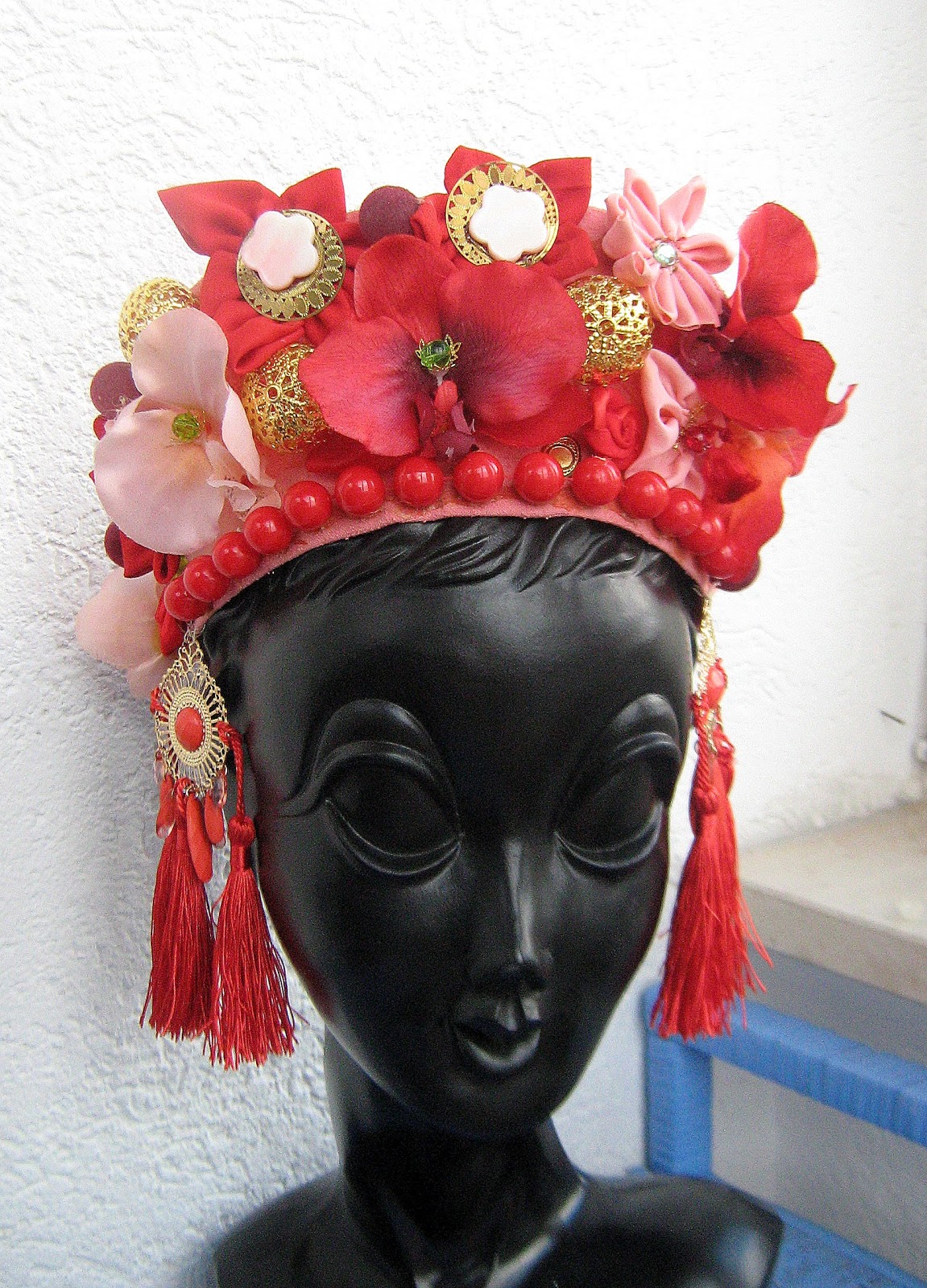
 The last dance I created was a chinese inspired ribbon dance -  I made it for a dance show of my dear friend and colleague Claudina; she just launched her fabulous veil dance instuctional DVD (view the trailer here!) and so I decided to do something that could match the program.
So the dance and the costume were more or less ready, and I wanted to add some more 'bling' to the quite simple dress. I did some research how to make the base for the headpiece; it has to look somehow like this:

So cut out the plastic base and bond it together with masking tape. Sometimes you can even use a tennis cap turned upside down. As you will cover it with fabric later it doesn't matter if the masking tape is visible.
After that cut the fabric generously in the shape of the base and glue it on the surface. Then fold the fabric along the edges and glue the overlap on the back side. Keep the fabric in place with pins and let dry.
Now the most tricky part is done and you just have to glue or stitch the decoration on the base. The pieces dangeling from the temples are made of earrings with some red tassels. The golden lace balls are a part of christmas decoration. I made Kanzashi flowers with fabric scarps from the costume and added also some fabric orchids and severy jewellery pieces. I can only recommend the Kanzashi flower makers from Clover. They are cheap and so easy to use, you can't go wrong! Fabric yoyos are also very easy to make and look gorgeous in the ensemble.
A broad elastic strap holds the crown on the head. If you do backbends make sure that you secure it additionally with bobby pins.

2012-09-21

So African, so Ethical, so Chic: Fabric Jewellery from Toubab Paris


http://csimg.webmarchand.com/srv/FR/29035672175007/T/340x340/C/FFFFFF/url/toubab-paris-collier-en-tissu.jpg http://csimg.webmarchand.com/srv/FR/29035672119869/T/340x340/C/FFFFFF/url/toubab-paris-bracelet-en.jpgtoubab_paris_bijou_400
Jewellery from Paris, made in Africa.
TOUBAB PARIS is the brainchild of Maud Villaret. Africa has alsways been a wonderful source of inspiratioon for her, where now the fabrics (wax) come from that she uses in her unique créations. All pieces are made by hand from local artisans in Burkina Faso. Her ethical approach coinvolves also centers for disabled workers in France as well as the association "Caravansérail Developpement" that offers help to socially and economically challenged immigrant women.
Have a look at the blog for the latest news!
Buy the products here.

2009-02-17

Tulips from East-Germany

No sign of spring until now... last night it was snowing again. Not that it is unusual in this time of the year. But my internal clock runs differently and I always have had enough of the winter several weeks too early (my mediterranean genes?).
So yesterday I decided to buy something that reminded me of flowers and colours, a combination of a vase and a candleholder, which I had been eyeing for several months in the window of an antique shop. These two pieces were made in the German Democratic Republic, i.e. here, but in Soviet times, probably in the sixties ot early seventies. The porcelain vase is a mass product, the surface is printed, but I found it irresistible because of its oriental pattern and the unusual shape.


This is a tiny remnant of the friendship and the mutual influence that linked the countries of the former Soviet Union and the Eastern Block. Although fabricated in central Europe it has a distinctively turkish-persian look adopted also by the central asian soviet republics.
The tulip with its round, turban-shaped blossom, is a often recalled motive in persian and turkish culture from Afghanistan and Central Asia, where the the flower and the name actually have their origin.
From there it took its way to Europe and much later a nameless German designer created this set as an hommage to some Soviet brother country far down in Asia.
Travelling in Eastern Europe I noticed a strong tendency towards asian-oriental patterns and accents very closed to kitch all over; I call it the "Soviet concrete baroque". But this is another story to be told another time... ;-)
Unfortunately, as you can see, the shape of the vase does not really fit the tulip, it is far to slim and high; I will have to wait for the daffodills to adorn it!

2008-12-22

Merry Christmas and scented gifts ;-)

Literally in the nick of time the gifts were ready ;-) I wanted to say "Thank you" to several people that had helped me a lot during last year, with the baby, with their support and so on... Finally I found a small company in Liguria, Italy that produces precious 100% pure olive oil cosmetics, pure luxury for body, mind and soul. I ordered 4 1kg bars, cut them into slices (don't ask me how many pieces I ruined until I realized that it is much easier to cut them if you lay the bars on the heating for half an hour or so...) and wrapped them into coloured banderoles which I had created just for this occasion.

Here they are all together put on a portuguese vintage tile. And now one by one:

Merry Christmas to you everybody! May you have a lovely and peaceful celebration full of happiness with all your beloved ones! Thanks for reading and support!

2008-12-19

Handmade Felt Messenger Bag

Look at this wonderful one of a kind handfelted
messenger bag! It is large enough to put inside all the books I need for my language classes ;-) and the strap fits perfectly to carry the bag diagonally, which is important if you ride a bicycle. And last not least I love the ornaments in different blue shades that remind me some mediterranean underwater landscapes with strange algae and marine animals.
My friend Antje made it on commission for me -I'm quite sure this is the best christmas gift I will get this year ;-) Thank you Antje!


LinkWithin

Blog Widget by LinkWithin