Showing posts with label Art. Show all posts

2013-07-16

Joy of Dancing: Kazakh Folk Dance Kara Zhorga

Now that's great I spend every day a lot of time browsing through youtube and call it "research" ... My new love is a Kazakh folk dance called Kara Zhorga (Qara Jorğa - K'ara Zhorg'a - Қара Жорға). It has been nominated for inscription in 2013 on the Representative List of the Intangible Cultural Heritage of Humanity.
One first example is a TV version featuring boys and girls in national garments:

 From the description (read full text here):

... According to A.Ismailov “Kara-Zhorga is a dance that embodies a variety of nuances and techniques. It combines bellicosity and buffoonery, tender pace and mobility, speed and calm grace” [...] Kara-Zhorga dance reproduces a picture of a traditional horse competition called bayge. "... Traditionally village residents gather for a feast (called “toy” in Kazakh). Young and cheerful horsemen step out from the crowd and start dancing - bending their bodies slightly forward, harshly swinging with their whips and eagerly entering in rhythmic competition. Young horsemen move in circles, lines and diagonals, out run each other, demonstrating agility of a leap or an intricate hop. The dance imitates horserace – rhythmically sharp-cut hops from one foot to another and big leaps with curving of a body compose major dance technique. A sharp-cut, rough and springy folk tune of Kara-Zhorga dance and the movement that coincides with the horserace rhythm, gracefully merge into a single image of bold horsemen – called “zhigit” in Kazakh, who master equestrian skills with their finger tips” (Sarynova, 1976: 37).
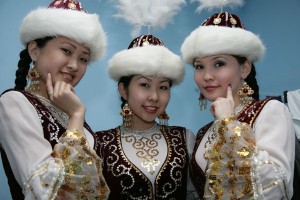
National dress
Overall the dance shows the agility skills and cheerful enthusiasm of a horseman who fully masters the art of riding a horse. [...]

The first notes of Kara-Zhorga dance were taken by artist and choreographer Aubakir Ismailov in 1928 during the meeting with Akhtai Mamanov, chief of amateur-talent group based at Kazkomuna boarding school in Petropavlovsk (city in northern Kazakhstan). [...]

In the pictures are some contemporary national Kazakh costumes; how can you not love those oodles of fluffiness, ruffles and trumpet sleeves?


Performers in traditional Kazakhstan costume 
Nowadays the dance is often performed at big social gatherings, celebration of festive events and even as a flashmob.

And some words about the spiritual meaning of the dance from the same document:

Researchers pay particular attention to initial sacral meaning of Kara-Zhorga, for the dance was mostly performed during “Shildekhana” ritual (feast in the name of newborn). Therefore Kara-Zhorga performance is closely linked with the time of child’s first initiation to the World, his/her acquaintance with the family and surrounding society. This period of human life along with the spiritual initiation and obsequies played most important role in nomadic culture.
Performing Kara-Zhorga for a newborn child aimed at introducing him/her with nomadic lifestyle, life on top of a horse. The tempo of the dance is sought to transmit the nomad’s main attitude to the reality of life; it sets up principal direction for future life of a newborn – meaning the way forward despite the obstacles, way of optimism and mobility. Moreover, performanc e of Kara-Zhorga bears purification and protective properties for both the child and the audience present. Appearing as a ritual and spiritual act, Kara-Zhorga gradually started to inherit characteristics of every day life. Owing to its deep semantic and symbolic meaning, Kara-Zhorga has been very popular among people over a long period of time, gradually acquiring new distinctive properties and styles.
Nowadays, Kara-Zhorga dance embodies the brightest features of Kazakh people and modern Kazakhstan, like – courage, vitality, musicality and mobility harmoniously intertwined with the scenery of beautiful and vast steppes. 

The whole thing looks like lots of fun if danced in a group among friends. On a more artistic level Kazakh ethnic dance presents all the finesse of Oriental stage dances with opulent costumes, delicate hand movements and hazardous backbends, as featured it this video by the magical Uighur dancer Dilnar Abdullah:

2013-04-05

Tutorial: Serouel M'douar - Algerian Urban Costume

So this part of the costume, the pants, are really easy, but it took me ages to find that out, because I couldn't find any desriptions of the cut of these particular pants (serouel in Algerian) that I never happened to see with my own eyes - all I had were photographs. 
The name - serouel m'douar - could have been a useful hint, if I had asked somebody. So the meaning of the name (m'douar means nothing else than "round") became clear to me after a couple of samples that I had tried to make. So here's the description.
You need upholstery fabric which is usually around 3 meters wide. Or you sew a piece which is at least twice as wide as the required length of your serouel (Does that make sense? Lenght: approx 1m; width 2-3m. It depends, how volouminous your serouel should look like and it depends of course on the characteristics of the fabric, stiif or soft, thick or thin).
Now fold your fabric twice. 
Cut out a quarter of a circle, or, if your serouel, like in this case, is longer than wide then the waist is the broadest part and the pants become slimmer towards the ankles in a rounded shape. A small piece between the feet is alredy united.


If you unfold the fabric now you should have a
two semicircular pieces eventually connected on the rounded side.

Pleat the waist, or simply gather it (pleats look less bulky).
Se the side seams and leave generous holes where you feet should go (leave at least 40 cm between them, otherwise you will not be able to walk!) 
Almost done. Waistband and hem at the feet are still missing, but the idea is clear.

2013-04-03

Algerian Urban Costume Step 1: Research

It is one of the worst of my habits not to finish one project before starting the next one... so here I am again.
My fingers have been itching a long time for this and since the other dancing ladies have expressed their interest to work on Algerian Andalusian Dance I am heading to this adventure right now.
The costume-to-be should represent the festive attire of a high-class lady from Algier roughly in the middle of the 19th century in order to create a choreography on classical Algerian Andaloussi Music (explanation will follow...)
The fabulous book of Leyla Belkaid: Costumes d'Algerie, Edtions du Layeur, Paris 2003 offers deep historical explanations and many historical photographs related to this issue.
Below are a couple of variations of a late 19th- early 20th century style of indoor clothing.
 
The first part to explore were the trousers. This particular style is called "serouel m'douar" and is used also nowadays with a slightly different silhouette; as modern ladies want to look more slim they use less and more delicate fabric.


For the historical garments thick and heavy jaquard textiles have been used for the trousers, most probably silk. Nowadays you can use upholstery fabric which has similar characteristics and is relatively cheap.
And here you can see a modern serouel m'douar:
(picture credit: here.)
In the next post I will show you how to sew such a serouel.

2013-04-01

Afghan Jewellery: or the Beauty of Archaic Art

There is something so alluring and feminine about Afghan Jewellery. Since discovered by the Hippie movement no festival and no Indian Summer can be imagined without it. The heavy and still elegant pieces can easily combined with any kind of western urban chic to unleash the gipsy princess within...
I am so happy thet I found the webshop of saneens where you can order all kind of Aghan jewellery, but also Antiques and traditional Afghan garments (there will be an extra post on these, stay tuned!).
I can only recomend this shop, they ship worldwide and really fast, plus they have a super friendly customer service in English .. just ask then anything!
Plus ... shhhh, this is our secret ;-) ... they offer a special discount for all Anarkali readers.
Use this coupon code at the ceckout to save 10% on you order!!

CI7622LNL3B6

 Are you still here? What are you waiting for! Rush to www.saneens.com!
Pendant with metal tassels
Earrings with small bells and coloured glass beads

Adornment for braids, can als be used as rings

Tikka of forehead adornement
Lapislazuli bangle


Bracelets 


Bracelets and headpiece


Picture credits: pictures 1, 3, 5, 6 from saneens.com

2013-03-26

Kalbelia Costume I: Needs a Lot of Patience


For an upcoming workshop of Kalbelia dance I threw myself into sewing a costume.
The skirt is the central piece as the dance is full of whirling and spinning (see the first picture).


With a readymade dance skirt from Hongkong purchased from here, lots of ribbons from my stock and some fabric to recycle the adveture began:


  The diamonds are cut out from the fabric and basted. A narrow white ribbon will cover the edges later.


Many many hours later: lots of greens and blues. Red, yellow and white will follow....

2012-12-19

eL Seed: Calligrafitti } Street Art Meets the Arab Revolution

Joobin Bekhrad talks to Tunisia's undisputed 'master' of Calligraffiti about art, religion, and the power of spray paint


Born and raised in France from Tunisian parents he always felt a strong connection to his arab-african roots. From here his decision to study Classical Arabis and then Arabic Calligraphy. He now infuses his culture into art, i.e. Arabic into Graffitti.


The Classical Arabic calligraphy has a lot in common with modern days grafitti - it plays with letters, distorts them in every way but still the message is at the center. With one very prominent difference: The authos in calligraphy steps behind his work which promulgates mostly quotations from the Quran.

http://www.reorientmag.com/wp-content/uploads/2012/09/lv_e7e30c100b597926a4f4d7c4e69f8d087142db0c.jpg
eL Seed’s ‘Calligraffiti’ on Tunisia’s tallest minaret

"This “Calligraffiti” is the product of a double marginality, that of an oriental artist seeking a voice in the occidental world and that of street art struggling to legitimize its presence in the contemporary art scene. This duality enables the reconciliation of two supposedly opposing worlds and two supposedly clashing cultures. eL Seed no longer tags his name on walls, deciding instead to adopt a proverbial tradition in which the art, not the artist, is the sole focus."
Read more in interviews here and here.
Picture credits here and here.

2012-10-22

2012-09-21

So African, so Ethical, so Chic: Fabric Jewellery from Toubab Paris


http://csimg.webmarchand.com/srv/FR/29035672175007/T/340x340/C/FFFFFF/url/toubab-paris-collier-en-tissu.jpg http://csimg.webmarchand.com/srv/FR/29035672119869/T/340x340/C/FFFFFF/url/toubab-paris-bracelet-en.jpgtoubab_paris_bijou_400
Jewellery from Paris, made in Africa.
TOUBAB PARIS is the brainchild of Maud Villaret. Africa has alsways been a wonderful source of inspiratioon for her, where now the fabrics (wax) come from that she uses in her unique créations. All pieces are made by hand from local artisans in Burkina Faso. Her ethical approach coinvolves also centers for disabled workers in France as well as the association "Caravansérail Developpement" that offers help to socially and economically challenged immigrant women.
Have a look at the blog for the latest news!
Buy the products here.

2012-06-12

Joy of Dancing: Anar Dana DVD Release

It arrived yesterday ... and I just had  to flip through the beautiful dances of the DVD to soak in the beauty immediately... like a yummy variety of fruits on a silver tray there are traditional and little know dances from a large number of places between North Africa and India, either performed by the Anar Dana group or by Helene herself, in carefully handsewn costumes - a feast for every lover of authentic dances of the East!
Featuring dances from:
Baluchistan, Rajasthan, Algeria, Georgia, Armenia, Turkey, Iran, the West Sahara, Morocco and Kurdistan.
I have written in a previous post about my beloved teacher Helene Eriksen and I simply can not get enough of her art!
If you love traditional Eastern dancing don't miss this opportunity, you can order the DVD at: mail@helene-eriksen.de.

2012-04-10

Shadi Ghadirian: Photography of the Surreal


Looking for inspiration for my new Ghajar (Qajjar) Persian dance costume I flipped throug many images on the web and found to my big surprise the photographs of Shadi Gharidian. Have a second look on them, because they do not reveal their mystery easily.

 I quote here the text of the Saatchi Gallery in the UK (I couldn't describe it better):
The Ghajar dynasty ruled Iran from 1794-1925; and from its inception photography was popular with the elite, documenting women as well as men. The images from this period tend to share stylistic devices: people are posed, usually as individuals rather than groups, in the very elaborate settings of their homes, often sat next to or holding prized possessions or objects of status. In photos of this period, women were permitted to be pictured in less formal dress within the privacy of their homes, and some members of the Shah’s harem were even photographed in tutus in accordance with his predilection for the ballet. Though Ghadirian’s images replicate the settings and traditional costumes of this time, her women are presented in a much more modest way in their postures and poses, in adherence to more ‘contemporary’ custom.

  Inspired by 19th century photographs from the Ghajar period – the first portraits to be permitted by religious law – Ghadirian carefully reconstructed the opulent style of these images with the help of many friends: borrowing antique furnishings and costumes, commissioning the painted backdrops, inviting them to pose in the images. Picturing each woman in a bygone era, each scene is jarringly interrupted by the presence of contemporary products – a phone, boom-box, hoover – pointing to a culture clash of tradition and progress. The women stare out from the photos with an unnerving directness, detached from their environment, and confident within themselves.
 Ghadirian’s Untitled from the Ghajar Series is shocking not only for its anachronistic props, but for the sheer brazenness of her subject: defiant in her gangsta posturing and holding a ridiculously large ghetto-blaster. Ironically, this image is most in keeping with her historical references, showing the self-possessed attitude of her sitter. In this piece Ghadirian’s surreal time-warp happens in reverse: the initial joke is that the 1980s radio is out of place in the antique setting, but it is the vintage scene and pose which is in fact much more modern. Ghadirian uses this subtle humour to describe a contemporary Iranian female experience of existing as if outside of time.


Shadi Ghadirian was born in 1974, Tehran, Iran and lives and works in there. 

She has my age and I try to imagine the life of a woman in those very different circumstances.


LinkWithin

Blog Widget by LinkWithin