
2013-03-26
Putting Things into Order ...
... is not my favourite issue.
But thinking of my two blogs I had to make a small correction.
I have moved everything oriental dance related to Anarkali, which is also my dance nickname.
So from now on you will find all my musings about costume making here.
On Saffron Yellow I will put everything which is not dance related, my other crafting activities and the mummy related things.
So if you are interested... just follow both of them!

On Reconstructing: What is "Authentic" in Ethnic Dance?
Now that the Kalbeliya costume is finally finished I have collected so many ideas in my head that I am working now not on one "historical" costume, but on two simultaneously.
(N.B.: Rereading this article I have the impression to have written an anti-tribal-fusion statement. I do not at all disrespect any kind of fusion work, on the contrary, it has it's own charm and is an artform in itself! But it has a totally different background than what I am trying to do in this moment.)
When I say "historical" costume this means that I do an accurate research on a specific region and a certain time period. Then I usually choose a whole outfit that I try to reproduce including accessoires like headpieces, shoes and jewellery. On this base I choose the matching music to form a dance out of that.
But when it comes to reconstruction there are a lot of different levels of historical accuracy to follow. How much must my work adhere to them?
Thinking of my next projects these are the questions I posed to myslf and also how to answer them for myself - regarding only my own work right now. I do not want to make any absolute judgements, I just want to clear my ideas in order to achieve a round and coherent outcome!
Can I mix pieces of different outfits?
The answer is difficult. As documentary material may be scarce I will be forced to invent something in any case. BUT - and this is crucial for me - I want to have a coherent work, this means, that if I borrow pieces (and, when it comes to dances, movements) from another, similar source, I want to make sure that the pieces will not loose their initial meaning by being put into an alien surrounding. This may sound really cryptic. I mean, that the pieces should match and should not be used out of their context regarding religion, social strata and regional peculiarity. So I would not combine, e.g. a peasant woman's apron with an urban headpiece.
Mixing signs of different religious or ethnic communities is not only a sign of a certain ignorance; it might even be regarded as an insult to a member of those. So be very careful with eclectic compositions and have always your audience in mind.
The gender aspect is also very important in non westernized societies. Although I see a certain shift in contemporary ethnic stage dance and costuming (e. g. in some of the new pieces of the sukhilshvilebi from Georgia) I'd rather leave those challenges of their own society to them. As an outsider I can never be sure what denotation it will create on the indigenous audience.
Whenever we approach and try to appropriate a different culture we should be very careful not to destroy the whole systems of meanings that holds it, otherwise we risk to act not only out of ignorance but in a colonialistic way.
This is what I mean by "authentic".
I know this sound sooo conservative! But where is my free artistic expression?! you may ask.
I find a lot of it even in this cautious approach. Some of the freedom comes simply out of material renouncement. I adore, for example, handloomed textiles, and love the very few scarfs that I own. But historical garments need a lot more fabric than our modern ones. And I would have to order them from India, and that is pricey. So, in this case I am very relaxed. I use modern, even synthetic, fabrics when I think they match the styling. I use my sewing machine, I use zippers, fabric glue, faux pearls, acrylic beads, glitter, and so on.
And I also adopt and combine modern crafting techniques which are completely non related to the historical background of a costume. So on a balkan style coat I will put not only the traditional gold work, but also holographic sequins and Japanese inspired Kanzashi flowers.
Last not least the music I like to use gives me the directions, how to incorporate modern techniques into an authentic dance costume and piece.
These are so far the limitations I put on myself for my work right now. And after that - I will probably make a completely crazy fusion thing! :-)
What is your opinion about all that? Please share!
(N.B.: Rereading this article I have the impression to have written an anti-tribal-fusion statement. I do not at all disrespect any kind of fusion work, on the contrary, it has it's own charm and is an artform in itself! But it has a totally different background than what I am trying to do in this moment.)
When I say "historical" costume this means that I do an accurate research on a specific region and a certain time period. Then I usually choose a whole outfit that I try to reproduce including accessoires like headpieces, shoes and jewellery. On this base I choose the matching music to form a dance out of that.
But when it comes to reconstruction there are a lot of different levels of historical accuracy to follow. How much must my work adhere to them?
Thinking of my next projects these are the questions I posed to myslf and also how to answer them for myself - regarding only my own work right now. I do not want to make any absolute judgements, I just want to clear my ideas in order to achieve a round and coherent outcome!
 |
| Modern version of a traditional Algerian costume - from a magazine of the famous Algerian Designer Samira Bezaouia Sadek |
Can I mix pieces of different outfits?
The answer is difficult. As documentary material may be scarce I will be forced to invent something in any case. BUT - and this is crucial for me - I want to have a coherent work, this means, that if I borrow pieces (and, when it comes to dances, movements) from another, similar source, I want to make sure that the pieces will not loose their initial meaning by being put into an alien surrounding. This may sound really cryptic. I mean, that the pieces should match and should not be used out of their context regarding religion, social strata and regional peculiarity. So I would not combine, e.g. a peasant woman's apron with an urban headpiece.
Mixing signs of different religious or ethnic communities is not only a sign of a certain ignorance; it might even be regarded as an insult to a member of those. So be very careful with eclectic compositions and have always your audience in mind.
The gender aspect is also very important in non westernized societies. Although I see a certain shift in contemporary ethnic stage dance and costuming (e. g. in some of the new pieces of the sukhilshvilebi from Georgia) I'd rather leave those challenges of their own society to them. As an outsider I can never be sure what denotation it will create on the indigenous audience.
Whenever we approach and try to appropriate a different culture we should be very careful not to destroy the whole systems of meanings that holds it, otherwise we risk to act not only out of ignorance but in a colonialistic way.
This is what I mean by "authentic".
I know this sound sooo conservative! But where is my free artistic expression?! you may ask.
I find a lot of it even in this cautious approach. Some of the freedom comes simply out of material renouncement. I adore, for example, handloomed textiles, and love the very few scarfs that I own. But historical garments need a lot more fabric than our modern ones. And I would have to order them from India, and that is pricey. So, in this case I am very relaxed. I use modern, even synthetic, fabrics when I think they match the styling. I use my sewing machine, I use zippers, fabric glue, faux pearls, acrylic beads, glitter, and so on.
And I also adopt and combine modern crafting techniques which are completely non related to the historical background of a costume. So on a balkan style coat I will put not only the traditional gold work, but also holographic sequins and Japanese inspired Kanzashi flowers.
 |
| Random material for goldwork on an velvet coat |
Last not least the music I like to use gives me the directions, how to incorporate modern techniques into an authentic dance costume and piece.
These are so far the limitations I put on myself for my work right now. And after that - I will probably make a completely crazy fusion thing! :-)
Completed! The Kalbelia Adventure
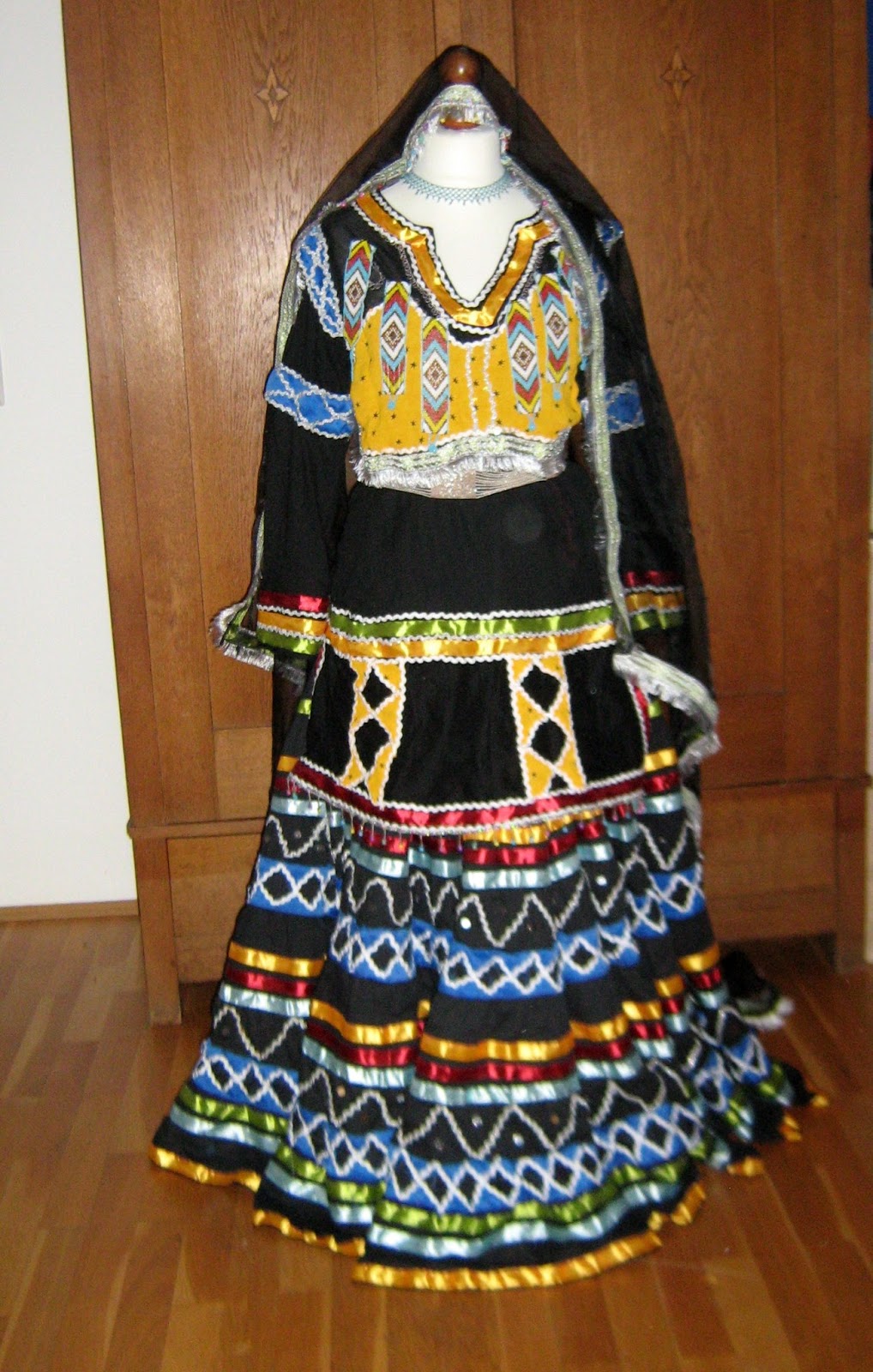
I can't believe it. The Kalbelia costume is ready - after months of stitching and using up kilometers of trims. You can see the humble beginnings here.
But now step by step - if you plan to make a costume like this yourself. Actually this costume was not very expensive in materials - I used very simple things that you can even find in your stash. But it was probably the most time-consuming project I ever made.
You need for the skirt:
2 (!) 3-tiers circular cotton skirts
The skirt you can see in the first post is actually only the first half of what I made. Then I realized that the skirt had to be wider so that it swirls beautifully.
Lots (!) of trims and ribbons. Cheap satin ribbons are the best. I cannot name the exact amount I used, but I used at least 25m of each colour.
Eventually some repurposed fabric in bright colours - in this case for the blue stripes on the skirt and the yellow pieces on the shirt with the cut-out diamonds.

The sequins have been glued on the skirt with fabric glue - you could sew them as well, of course, but I didn't want to spend much time.

The microbeaded stripes were the most expensive parts of the costume. Maybe I'll try to make them myself one day, beadweaving shouldn't be that complicated. The patterns are simple and you can make those stripes using a beadloom or even without.
The veil is made of very simple synthetic organdy and I just I added a silver fringed trim and a green ribbon for contrast.
So this is the result of months of research, and of stitching. We are just waiting for the next performance!
Tutorial: Chinese Inspired Headpiece
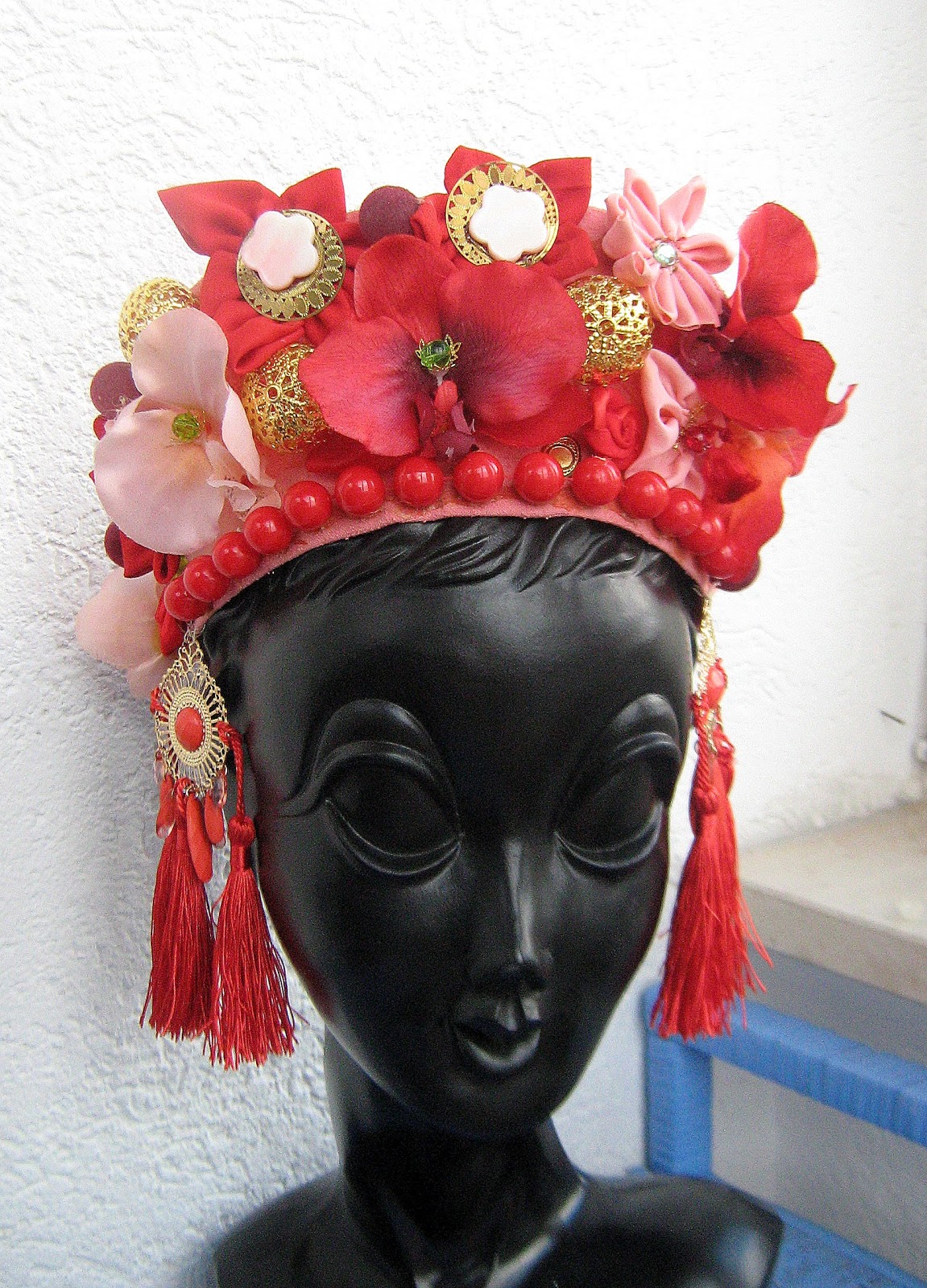
So the dance and the costume were more or less ready, and I wanted to add some more 'bling' to the quite simple dress. I did some research how to make the base for the headpiece; it has to look somehow like this:

After that cut the fabric generously in the shape of the base and glue it on the surface. Then fold the fabric along the edges and glue the overlap on the back side. Keep the fabric in place with pins and let dry.

Now the most tricky part is done and you just have to glue or stitch the decoration on the base. The pieces dangeling from the temples are made of earrings with some red tassels. The golden lace balls are a part of christmas decoration. I made Kanzashi flowers with fabric scarps from the costume and added also some fabric orchids and severy jewellery pieces. I can only recommend the Kanzashi flower makers from Clover. They are cheap and so easy to use, you can't go wrong! Fabric yoyos are also very easy to make and look gorgeous in the ensemble.
A broad elastic strap holds the crown on the head. If you do backbends make sure that you secure it additionally with bobby pins.

Tutorial: Qawwali Caps

First we had to choose a model for the cap.
The Qawwali cap for women is modelled on the shape of the taqiyah cap for men - a traditional (prayer) cap worn by observant muslims. There are different shapes with different names all over the muslim world, but they are variations of the small short rounded prototype.
We chose a model with an oval base and two points, with an ostrich feather.

So the most tricky thing was to find the exact basic shap. Since the center is oval i cannot give you any directions how to calculate the exact pattern. And probably it is more simple if you measure the circumference of your head ar the point you want to wear the capwith a paper strip and then to try to draw an oval shape that has the circumference of the same length like the strip.


I had to throw away the first set of ovals because I just drew them from my imagination and the caps were then way to small!
The second batch worked quite well.
Now you have the base.
You can line it and glue some other fabric remnant on the wrong side. Or you just leave it unlined, that depends on the fabric and on how stiff you want the cap to be (you can stiffen it later, too).
Then comes the most funny part: decorating!!
Grasp everything shiny and glittering you find in your stash or in the dollar store.
Earrings, feathers, ribbons. Exspecially around christmas you can find great metallic ribbons for almost no money.
Add hotfix stones (not in the picture) and GLUE!


I couldn't glue the metallic trim, so I had to sew it, but glueing will save you a lot of time.
Then the feathers: Unite a youple of them to a bunch and fix it with maskin tape. Make now a small pocket of the same tape, but inverse in order to insert the featers here. Hide the pocket behind a "jewel". You can also glue the feathers here right away, but I wanted them to be detachable. You never know how you will transport your cap, and after a performance maybe you just want to toss it into your suitcase.


And glue!

Finally add a thin elstic strap to secure the cap on your head, eventually use also some bobby pins.
Done!!
Kalbelia Costume I: Needs a Lot of Patience
For an upcoming workshop of Kalbelia dance I threw myself into sewing a costume.
The skirt is the central piece as the dance is full of whirling and spinning (see the first picture).

With a readymade dance skirt from Hongkong purchased from here, lots of ribbons from my stock and some fabric to recycle the adveture began:

 The diamonds are cut out from the fabric and basted. A narrow white ribbon will cover the edges later.
2013-03-12
Archaic Beauty: A Kosovar Wedding in the Village of Donje Ljubinje

These pictures have been shown around the blogsphere quite a while but still I feel I have to share them - they look like from a fairy tale or another world.


Bosnian bride Senita Demirovic has her face painted on her wedding day for a traditional ceremony in the village of Donje Ljubinje, Kosovo.
Donje Ljubinje is situated in the Shar mountains that form the border between Kosovo and
Macedonia. The inhabitants call themselves 'Torbesh'.
Pictures by Valdrin Xhemaj. Credits: here.
If you want to be in a dream for a couple of minutes watch here:
Subscribe to:
Comments (Atom)
LinkWithin
