Showing posts with label India. Show all posts

2013-03-26

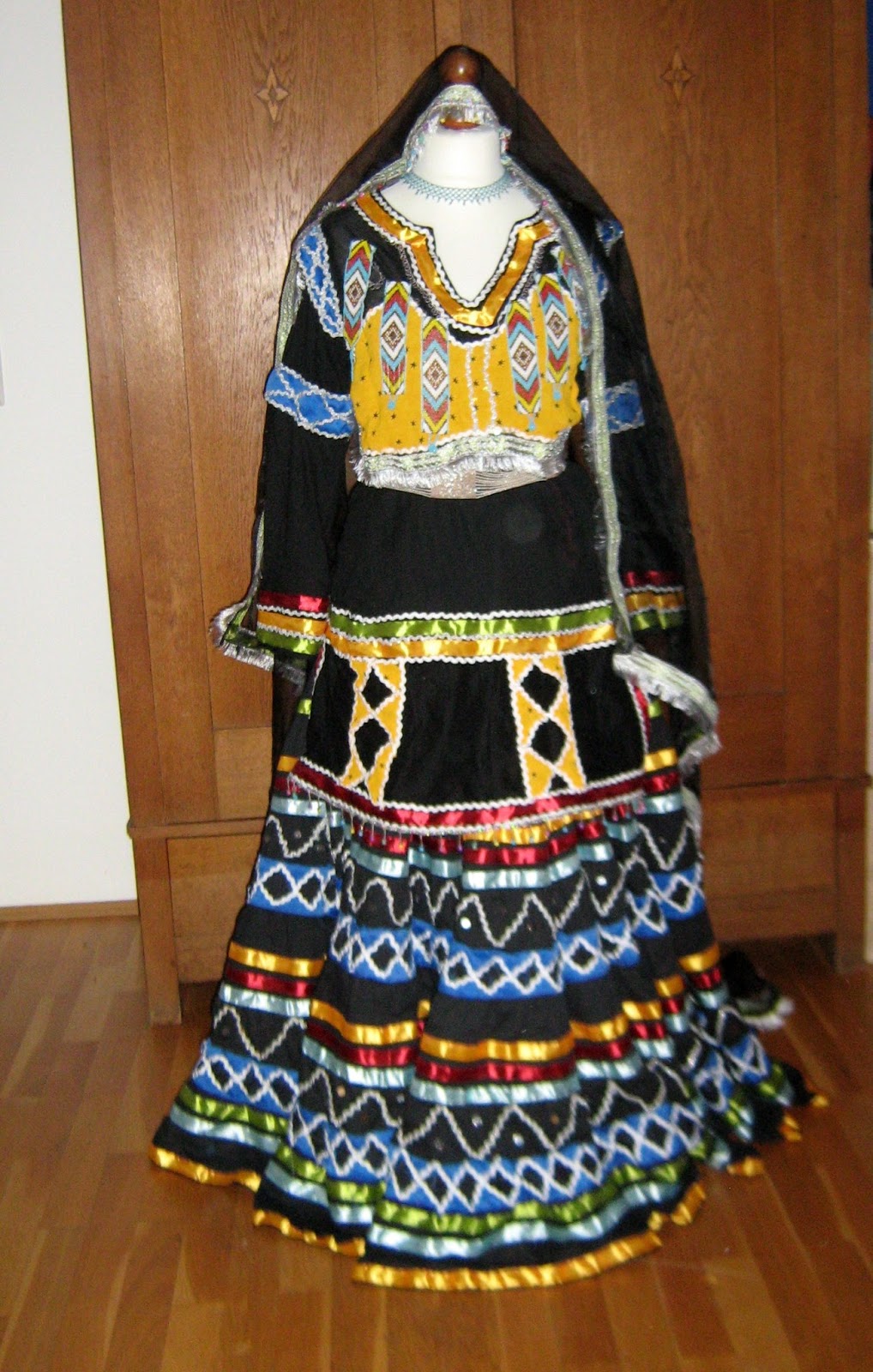
Completed! The Kalbelia Adventure

I can't believe it. The Kalbelia costume is ready - after months of stitching and using up kilometers of trims. You can see the humble beginnings here
But now step by step - if you plan to make a costume like this yourself. Actually this costume was not very expensive in materials - I used very simple things that you can even find in your stash. But it was probably the most time-consuming project I ever made.
You need for the skirt:
2 (!) 3-tiers circular cotton skirts
The skirt you can see in the first post is actually only the first half of what I made. Then I realized that the skirt had to be wider so that it swirls beautifully.
Lots (!) of trims and ribbons. Cheap satin ribbons are the best. I cannot name the exact amount I used, but I used at least 25m of each colour.   
Eventually some repurposed fabric in bright colours - in this case for the blue stripes on the skirt and the yellow pieces on the shirt with the cut-out diamonds.
In my first post I explained how I cut out the diamonds - actually a second time I'd probably first cut the diamonds out and add the white rickrack trim with hand stitches first before stitching it on the skirt with the machine. But it works both ways.
The sequins have been glued on the skirt with fabric glue - you could sew them as well, of course, but I didn't want to spend much time.
Then you'll need an already existing cotton blouse. I added some more length with some more cloth - this is optional.
The microbeaded stripes were the most expensive parts of the costume. Maybe I'll try to make them myself one day, beadweaving shouldn't be that complicated. The patterns are simple and you can make those stripes using a beadloom or even without.
The veil is made of very simple synthetic organdy and I just I added a silver fringed trim and a green ribbon for contrast.
So this is the result of months of research, and of stitching. We are just waiting for the next performance!

Tutorial: Qawwali Caps

Ready to go - here are the six Qawwali Dance Caps for my dear friends from the Indo-German Dance Duo Srijan. It was not easy to create those caps from the scratch, so I will show you now the most important steps so that you can avoid the mistakes I made on the way!
First we had to choose a model for the cap.
The Qawwali cap for women is modelled on the shape of the taqiyah cap for men - a traditional (prayer) cap worn by observant muslims. There are different shapes with different names all over the muslim world, but they are variations of the small short rounded prototype.
We chose a model with an oval base and two points, with an ostrich feather.  

So the most tricky thing was to find the exact basic shap. Since the center is oval i cannot give you any directions how to calculate the exact pattern. And probably it is more simple if you measure the circumference of your head ar the point you want to wear the capwith a paper strip and then to try to draw an oval shape that has the circumference of the same length like the strip.


I had to throw away the first set of ovals because I just drew them from my imagination and the caps were then way to small!
The second batch worked quite well.
Now you have the base.
You can line it and glue some other fabric remnant on the wrong side. Or you just leave it unlined, that depends on the fabric and on how stiff you want the cap to be (you can stiffen it later, too).

Then comes the most funny part: decorating!!
Grasp everything shiny and glittering you find in your stash or in the dollar store.
Earrings, feathers, ribbons. Exspecially around christmas you can find great metallic ribbons for almost no money.
Add hotfix stones (not in the picture) and GLUE!

 I couldn't glue the metallic trim, so I had to sew it, but glueing will save you a lot of time.
Then the feathers: Unite a youple of them to a bunch and fix it with maskin tape. Make now a small pocket of the same tape, but inverse in order to insert the featers here. Hide the pocket behind a "jewel". You can also glue the feathers here right away, but I wanted them to be detachable. You never know how you will transport your cap, and after a performance maybe you just want to toss it into your suitcase. 

 Now add all the other decorations you want. Nip off superfluous rings from the metal pieces.
And glue!
For the final shape of the cap use some cheap, sticky hair spray. Spray abundantly on the inside of the cap  and while wet, mould it into the right shape.
Finally add a thin elstic strap to secure the cap on your head, eventually use also some bobby pins.
Done!!

Kalbelia Costume I: Needs a Lot of Patience


For an upcoming workshop of Kalbelia dance I threw myself into sewing a costume.
The skirt is the central piece as the dance is full of whirling and spinning (see the first picture).


With a readymade dance skirt from Hongkong purchased from here, lots of ribbons from my stock and some fabric to recycle the adveture began:


  The diamonds are cut out from the fabric and basted. A narrow white ribbon will cover the edges later.


Many many hours later: lots of greens and blues. Red, yellow and white will follow....

2012-11-02

Joy of Dancing: Bihu from Assam


http://www.tezpuronline.in/link_page/images/AGSU%20MUKALI%20BIHU.jpg
picture credits: here.

The Rongali Bihu is the festival of the Assamese New Year which falls in mid-April. It also marks the arrival of Assamese New Year(around April 15). Through this festival, which stretches for several days, the Assamese people welcome the season of seed sowing and pray for a great harvest. During the festival Bihu dance is performed by both young men and young women. The dance is performed accompanied by Bihu folk music based on love theme which are generally dominated by men, though there are songs that are sung by women as well, Bihu dance is characterized by quick dance movements, swift hand steps and rhythmic swaying of the hips.The dance is performed on folk songs known as Bihu Songs. Pepa a flute made of buffalo horns), dhol (a drum), tala (a cymbal), gogona (a bamboo instrument) and toka (a bamboo clapper) are the instruments used in these songs. Different tribes have made slight variation in the dance and have named it after their tribe like Garo Bihu Dance, and Khasi Bihu Dance.
The movements of the Bihu dance draw from many traditions - Indo-Aryan, Austro-Asiatic and Sino-Burmese.
File:Bihu dance with japi.jpg
 picture credit: here.

In the picture above girls are dancing with colourful straw hats called jaapi. Jaapi (Assamese: জাপি) is a traditional Assamese headgear or hat of Assam, India. Jaapi is made of tightly woven bamboo and/or cane and tokou paat (Trachycarpus martianus) a large palm leaf. Simpler hats are worn by the farmers for protection from the sun.


https://blogger.googleusercontent.com/img/b/R29vZ2xl/AVvXsEiuFOWSvhXcYqut3Wn-OF4rEwtBDX5rBtJf22DHlWoxLi4HiBikVX3DYP-pM3FlPbPTwmJa1nESC3JMGHj8dDS7cLkkVv3pXN3zyCHf6rK0d-1N-uOvQXetYuu2YGJgOAlJmszJh_lFPVo/s1600/Gaamkharu.jpg
 Gaamkharu is a traditional Assamese ornament used by female bihu dancers made of Silver.

The costume of the male dancers is called dhoti and gamocha. Women wear Chadar Mekhale, two pieces of fabric draped around the body. Usually it is made of one of the very appreciated Assamese silks or of cotton with woven geometrical patterns. Read an amazing article on the silk production in Sualkuchi here.

http://indianyarn.files.wordpress.com/2009/12/mekhalchadar.jpg?w=426&h=287
picture credit: here.


sources: here, here and here.


Pictures by Edgar Nolte.
I have tried to learn this dance, above you can se some snaps from a performance.

View some beautiful bihu songs and dance videos:


2012-06-12

Joy of Dancing: Two Performances in One Weekend

This weekend I was really lucky. I performed Saturday at the opening vernissage for the exhibition of the lovely paintings of Djamilia Hergenreder at the Frauenzentrum Weimar.

Djamilia is a wonderful painter and such a sweet person. On the pics you see me performing classical Persian dance from the Qajjar period. The little plates on the second picture are "played" with thimbles. Unfortunately my little daughter lost one of them somewhere playing, so I had to fabricate something with a ring and a rubber band to make a sound also with my right middle finger ;-) But it worked out well.


The second performance was with the "faires Frühstück", a breakfast with biological and fair traded goods to rise awareness for the circumstances of the production and trade of our daily food.
We were welcomed with fair traded roses, had a yummy biological buffet and a lot of other treats!
The main theme was "India" So I performed folklore dances from Gujarat, Rajasthan and Assam.
The whole morning we broadcasted live from the terrace - with lots of Indian music!!

The Radio Team on the terrace.
Bihu dance from Assam.
But performing on the flint (!!) was terrible... my feet still itch when I look at the pics!
But everything was so nice, we had such a supportive audience and this made me forget everything :-)

2011-12-21

Naarghita: Music from the Heart

There is nothing new under the sun. No, really.

When couple of years ago a new trend swept through the Oriental dance scene - "Bollywood Dance" - everybody was enchanted by the sweet, romatic songs of Indian cinema and the combination of sparkling costumes and exotic dance movements. But it had already a history.
In the countries of the former Soviet Union (as well as in many Arabic and African countries) Indian films were very popular; they were a somehow "eastern" response to the omnipresent Hollywood cinema, transporting more conservative family values, without nudes, kisses etc.
In this context we encounter Naarghita, a singer and dancer from Romania, whose story still sparkle somehow like a fairy tale.
Maria Amarghioalei was born January 14, 1939, in the village of Pufeşti, in Romania. When she was three her parents separated and her mother moved to Bucharest, while she stayed with her grandparents until she was nine when she followed her mother to the capital. There she studies classical dance and singing and enters a corps de ballet. In 1956 she watches the movie "The Vagabond" ("Awaara" - 1951) by Raj Kapoor and falls in love with Indian music and dance. She learns the songs by ear and has her debut in 1957 with the song "Chand" ("Moon") from this film which is accepted enthousiastically by the audience.
 Then she starts deepening her knowledge on Indian culture studying Hindi for severy years and a professor from the Bucharest university procures her a saree and the scores of Indian songs.

(please note the typical "Bollywood" handgestures on the pictures!)


Narghita experienced true celebrity and brilliance in the 60s and 70s. Throughout her career, she gave concerts around the world: England, USA, France, Lebanon, Egypt. Millions applauded her, burning for the romanitic songs from India.

In this video you can clearly see the "Bollywood" moves that also contemporary oriental dancers use:


In 1967, Indira Gandhi noted Narghita her during a visit which he made in Romania and, stunned by the talented artist, took her to India where she met her idol Raj Kapoor. in 1972 she also acts in aBollywood movie.
From 1959 to 1991 she published a dozen of records with Indian songs, then she mysteriously disappears and leaves the trace of a true legend.


2011-06-22

The Wedding

Oh happy day! We were all prepared, waiting for the great moment, watching happy dances...

... the offerings were ready...
... and so were auspicious signs on feet ...
... and hands.
We all partecipated from the depth of our hearts, showering blessings...
... petals and hoorays on the newly-married couple.
Everything, even the most heart-warming ceremony, has to come to and end...
... and leaves us to chat, laugh and socialize where new bonds are being tied.
I wish you all the best for your new life, my dear sister!


2011-06-20

Busy Days in Pune

In those very busy days we enjoyed shopping, driving to the market in those very cosy rikshaws...
... mingling with all those busy ladies...
... neither minding the torrid sun, nor polluted air nor crowded alleys and shops.
Choosing from the brightest colours...
... and all kind of goods.

Where the sacred and the profane are nearly indisdiguishable...

Unforgattable days in Pune, Maharashtra, India.

2011-06-12

Wedding Preparations: A Women's Day

The most important day for a woman needs a lot of preparations!
Concentration...
And even more concentration...

... is needed to accomplish the masterpiece.


But also the laughter...
... and joy!
And of course readymade food! Who wants to cook with mehndi on her hands?
Hungry after a long day...

And the most beautiful hands I ever had!!

LinkWithin

Blog Widget by LinkWithin